
Study explores the link between ‘inflammaging’ and heart ageing
A recent study highlights a phenomenon that is still little known but plays a decisive role in cardiovascular ageing: ‘inflammaging’. What can be done to limit its effects?


Inflammaging: when chronic age-related inflammation weakens the heart
The term ‘inflammaging’ refers to a chronic, low-grade inflammation linked to ageing that develops silently, persistently, and without any immediate apparent cause (pathogen, trauma, etc.).
This latent inflammatory state is thought to lead to the functional decline of several organs, including the heart. A recent scientific review, published in 2026, details precisely how inflammaging influences cardiovascular ageing (1).
How does inflammaging affect the ageing of the heart?
Senescent cells, the cause of inflammaging
At the heart of the concept of inflammaging lie senescent cells. These are ‘ageing’ cells that have lost their ability to divide (2). Far from being inert, they remain metabolically active and adopt harmful behaviour. Over time, they accumulate in tissues — including the heart muscle and blood vessels — and disrupt their normal functioning.
SASP: a chronic inflammatory signal
Senescent cells secrete a complex set of molecules known as SASP (Senescence-Associated Secretory Phenotype) (3). This cocktail includes:
- pro-inflammatory cytokines (such as IL-6, TNF-α);
- chemokines;
- extracellular matrix remodelling enzymes;
- growth factors (including GDF-15).
This secretory profile sustains chronic local inflammation and facilitates the spread of senescence to neighbouring cells. Certain SASP markers, such as GDF-15, are also associated with a poor prognosis in several cardiovascular diseases.
Direct effects on the heart and blood vessels
The study highlights the concrete consequences of inflammaging on the cardiovascular system. The following were noted:
- increased vascular stiffness;
- endothelial dysfunction (the inner lining of blood vessels);
- progressive cardiac remodelling.
These changes reduce the blood vessels’ ability to dilate properly, destabilise blood flow and increase the heart’s workload, which in the long term may increase cardiovascular risk (4).
A vicious circle between inflammation and cellular ageing
The review also highlights the existence of a vicious circle between inflammaging and cardiac ageing. Chronic inflammation promotes the emergence of new senescent cells, which, in turn, amplify the inflammatory response via the SASP. This self-perpetuating system directly contributes to accelerating cellular and tissue ageing, particularly in the heart.
Can we intervene in inflammaging and senescent cells?
Targeting senescent cells
Research is increasingly focusing on so-called ‘senolytic’ strategies, aimed at eliminating senescent cells or limiting their harmful effects.
Certain natural compounds are attracting growing interest. One such compound is fisetin, a polyphenol found notably in strawberries, which is being studied for its potential ability to support the self-destruction of damaged cells (including senescent cells) and to activate the autophagy mechanism (which cleanses and recycles cellular waste) (5).
 The Fisetin supplement boasts a record-breaking fisetin content (500 mg per 2 capsules).
In the field of cellular longevity, quercetin is also making quite a name for itself. This powerful antioxidant flavonoid supports cardiovascular health by normalising blood pressure and endothelial function, as well as by curbing low-grade inflammation (6).
Super Quercetin is based on a patented anhydrous quercetin that is 170% more absorbable than standard forms.
It is worth noting that there are synergistic formulas combining several senolytic active ingredients that address the various aspects of cellular senescence.
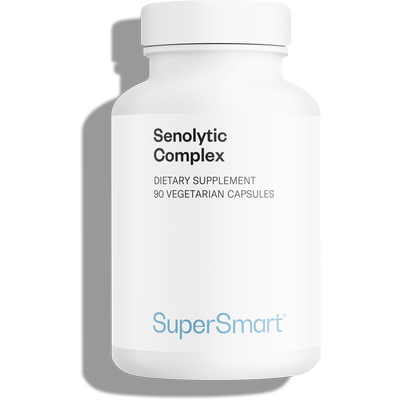
In addition to quercetin and fisetin, Senolytic Complex contains the most prominent compounds in anti-ageing research: green tea, bromelain, NMN, vitamin C...
Reducing low-grade inflammation
Reducing chronic inflammation amounts to tackling inflammaging at its root. Several natural active ingredients are thought to possess a certain ability to modulate inflammatory pathways.
Research suggests, for example, that apigenin may inhibit the expression of several pro-inflammatory compounds (NF-κB, COX-2, etc.) and mitigate oxidative stress in an inflammatory context. It also appears to have the ability to increase levels of NAD+, a key player in cellular metabolism (7-8).
Discover Liposomal Apigenin, a form with excellent bioavailability that delivers 200 mg of apigenin per capsule.
PEA (palmitoylethanolamide) is a bioactive lipid produced by most of our cells in response to stress. By modulating inflammatory signalling (activation of PPAR-α receptors, interactions with the endocannabinoid system, etc.) and regulating the activity of mast cells (a specific type of immune cell), it may help to limit excessive inflammatory responses (9).
Available in PEA, a patented form made from certified sustainable palm oil.
Supporting cellular and mitochondrial functions
Mitochondria, the energy powerhouses embedded in the cytoplasm of cells, play a role in the synthesis of ATP (cellular energy) and in managing oxidative stress (10). However, as we age, their performance declines: they produce less energy, neutralise free radicals less effectively and provide less support to cellular repair systems. This mitochondrial dysfunction thus appears to be closely linked to inflammaging and cellular senescence.
Supporting their activity is therefore an excellent complementary strategy. And this is where NAD+ comes in! Indeed, this coenzyme supports ATP production, activates sirtuins (enzymes involved in cellular longevity) and works in tandem with PARP enzymes responsible for DNA repair (11). Unfortunately, its levels decline with age.
NAD+ Booster Formula combines the 3 best NAD+ ‘boosters’, including the exclusive ingredient BluNAD Booster™ (a blend of pomegranate fruit peel extract and marigold flower extract).
SUPERSMART’S ADVICE
References
- Zanders L, Arifaj D, Wagner JUG, Dimmeler S. Cellular Senescence, Inflammaging and Cardiovascular Disease. Immunol Rev. 2026 Jan;337(1):e70084. doi: 10.1111/imr.70084. PMID: 41546123; PMCID: PMC12811516.
- Regulski MJ. Cellular Senescence: What, Why, and How. 2017 Jun;29(6):168-174. PMID: 28682291.
- Coppé JP, Desprez PY, Krtolica A, Campisi J. The senescence-associated secretory phenotype: the dark side of tumor suppression. Annu Rev Pathol. 2010;5:99-118. doi: 10.1146/annurev-pathol-121808-102144. PMID: 20078217; PMCID: PMC4166495.
- Barcena ML, Aslam M, Pozdniakova S, Norman K, Ladilov Y. Cardiovascular Inflammaging: Mechanisms and Translational Aspects. 2022 Mar 16;11(6):1010. doi: 10.3390/cells11061010. PMID: 35326461; PMCID: PMC8946971.
- Sun Y, Qin H, Zhang H, Feng X, Yang L, Hou DX, Chen J. Fisetin inhibits inflammation and induces autophagy by mediating PI3K/AKT/mTOR signaling in LPS-induced RAW264.7 cells. Food Nutr Res. 2021 Mar 25;65. doi: 10.29219/fnr.v65.6355. PMID: 33841067; PMCID: PMC8009086.
- Lee KH, Park E, Lee HJ, Kim MO, Cha YJ, Kim JM, Lee H, Shin MJ. Effects of daily quercetin-rich supplementation on cardiometabolic risks in male smokers. Nutr Res Pract. 2011 Feb;5(1):28-33. doi: 10.4162/nrp.2011.5.1.28. Epub 2011 Feb 28. PMID: 21487493; PMCID: PMC3061266.
- Oriquat G, K Abdulsahib W, Thaer Abdal-Wahab S, Malathi H, Mohanty B, Janney JB, Arora V, Sinha A, Aminov Z. The effects of apigenin on immune responses and inflammatory biomarkers in sepsis: a comprehensive systematic review. 2026 Apr 2:1-13. doi: 10.1080/1354750X.2026.2641063. Epub ahead of print. PMID: 41803677.
- Escande C, Nin V, Price NL, Capellini V, Gomes AP, Barbosa MT, O'Neil L, White TA, Sinclair DA, Chini EN. Flavonoid apigenin is an inhibitor of the NAD+ ase CD38: implications for cellular NAD+ metabolism, protein acetylation, and treatment of metabolic syndrome. 2013 Apr;62(4):1084-93. doi: 10.2337/db12-1139. Epub 2012 Nov 19. PMID: 23172919; PMCID: PMC3609577.
- Clayton P, Hill M, Bogoda N, Subah S, Venkatesh R. Palmitoylethanolamide: A Natural Compound for Health Management. Int J Mol Sci. 2021 May 18;22(10):5305. doi: 10.3390/ijms22105305. PMID: 34069940; PMCID: PMC8157570.
- Cooper GM. The Cell: A Molecular Approach. 2nd edition. Sunderland (MA): Sinauer Associates; 2000. Mitochondria. Available from: https://www.ncbi.nlm.nih.gov/books/NBK9896/
- Yusri K, Jose S, Vermeulen KS, Tan TCM, Sorrentino V. The role of NAD+ metabolism and its modulation of mitochondria in aging and disease. NPJ Metab Health Dis. 2025 Jun 18;3(1):26. doi: 10.1038/s44324-025-00067-0. PMID: 40604314; PMCID: PMC12177089.
Keywords





4 Days
Super fast delivery
Super fast delivery. Trying flexismart at the moment, Maybe a bit too soon to see results bit nice tolérance so far.
Maria Angeles Verdu
4 Days
Good service
Supersmart are an efficient company - the order arrived quickly. This is usual for them, though they have occasionally been let down by delivery firms - not a surprise and not their fault.
Barry Humphries
6 Days
Excellent product
Excellent product, quick delivery
FERENCNE Soros
8 Days
High quality, reliable service!
I have been ordering their products for years! They are excellent quality. And despite the international shipping, my order allways arrived pretty fast. The loyalty program is very fair, I get great prices on the products. Imagine: my specialists are asking me what have I been taking that my counts are so good!
Petra Hruskova
9 Days
I purchased Melatonin
I purchased Melatonin, very quick delivery to the UK and product is perfect. Very Happy
Dean Harriss
11 Days
Avis général
Well boxes are white but that puts a bit of serious color for my grey matter. Supersmart is quality products and made myself a pharmacy. Honestly should be remboursed by the health institutes selling pills
LEBORDAIS Thomas
12 Days
Arrives in just five days even to Japan…
Arrives in just five days even to Japan – that’s insanely fast! Amazing lineup of innovative products.
namio
14 Days
Quality and choice of supplements.
Quality and choice of supplements.
Maja
19 Days
perfect great
perfect great
igor janic
24 Days
Good products and speedy delivery
Good products and speedy delivery
Jim
27 Days
Very good
Very good, fast delivery
Paddy
28 Days
Excellent products
Excellent products. Excellent servce.
MIFSUD Joseph
28 Days
It was sent expediently
It was sent expediently, the tracking worked nicely!
Roger De Backer
30 Days
Everything okay
Quality products people can account on. Fast shipping.
Fred Laan
41 Days
Good products
Good products
Emmanuel
of experience
your money back
##montant## purchase