
Does eating more choline reduce the risk of neurological disorders?
Known for its key role in several essential functions in the human body, choline is increasingly being studied for its links with brain and cognitive health. New data is opening up interesting prospects...


What is choline?
Choline (from the Greek khole, bile) is a nutrient that was long considered to be a B vitamin, before it was discovered that the human liver could produce small quantities of it.
However, the amount produced endogenously is still insufficient to meet the body's needs, making dietary intake essential.
Choline is known for several of its benefits:
- It contributes to the normal metabolism of homocysteine by helping to regulate this amino acid, high levels of which are often associated with an increased risk of cardiovascular or bone disorders.
- It contributes to normal lipid metabolism: as a precursor of phospholipids, choline also acts with the bile acids present in bile to facilitate the absorption of lipids.
- It helps maintain normal liver function: an adequate intake helps limit the accumulation of fat in the liver and supports healthy liver function.
Choline is also used by the body to produce acetylcholine, a neurotransmitter involved in memory, learning and muscle control.
So can we deduce that consuming more choline could support the synthesis of acetylcholine and, indirectly, cognitive performance?
Choline and brain health: what does the latest scientific research suggest?
Recent scientific publications suggest that a good level of choline in the body could help preserve certain cognitive functions over the years.
Researchers have studied the effects of dietary choline intake on the deterioration of cognitive functions during the ageing process (1-2).
Another study showed that a high intake of choline was associated with lower levels of anxiety (3).
Research has also looked at the effects of citicoline, a natural compound that acts as a precursor to essential cellular nutrients, including choline. Some studies have shown potential benefits in improving memory function in older adults with memory problems (4-5).
These studies suggest that there may be a link between adequate choline consumption and memory maintenance, a reduction in age-related cognitive decline and a reduction in the risk of neurological disorders.
One explanation for this link is choline's key role as a precursor of acetylcholine.
With age, acetylcholine synthesis tends to decline, which could contribute to the cognitive problems observed in some people.
Maintaining a sufficient intake of choline could therefore help, in a preventive way, to support this synthesis and preserve certain cognitive functions over time.
How can we optimise our daily intake of choline?
As well as eating choline-rich foods, targeted supplementation can help to ensure adequate daily intakes.
Eat foods rich in choline
Choline is found in varying quantities in foods of animal and plant origin, in the form of phosphatidylcholine or sphingomyelin (two phospholipids that are part of the main constituents of the membranes surrounding cells).
The best sources of choline include the following foods (average choline values per 100 g):
Animal products (rich in phosphatidylcholine and sphingomyelin):
- beef liver: 333 mg
- whole eggs: 301 mg (the yolk is the richest part)
- salmon: 94 mg
- beef steak: 92 mg
- chicken breast: 82 mg
- pork chops: 60 mg
- cooked cod: 71 mg
Plant sources (choline mainly in the form of phosphatidylcholine):
- soya beans: 107 mg
- white beans: 66 mg
- almonds: 52 mg
- walnuts: 39 mg
- quinoa: 43 mg
- broccoli: 19 mg
- cauliflower: 24 mg
Including these foods in your diet on a regular basis will bring you closer to the European Food Safety Authority (EFSA) recommended intake of 400 mg/day for adults (6).
Adjust your intake according to your needs
Choline requirements vary according to age, sex and lifestyle.
For adults, an adequate intake is estimated at 400 mg/day, but this increases to 480 mg/day for pregnant women and 520 mg/day for breastfeeding women. Several studies have reported the role of choline in the development of cognitive functions in children (7).
Certain situations can also increase the risk of deficiency, such as vegetarianism, the menopause or intensive endurance sports (8-9).
Choose the most bioavailable forms of choline
Choline comes in several forms, differing in chemical structure and bioavailability.
As we have seen, in the diet it is found mainly in the form of phosphatidylcholine and sphingomyelin.
In supplements, other forms are used:
- choline bitartrate: a form commonly used in food supplements for its good absorption
- alpha-glycerophosphocholine (Alpha-GPC): a highly bioavailable form of choline
- CDP-Choline or citicoline: a patented form with exceptional bioavailability
 Discover Choline Complex, which combines these three forms of choline in a synergistic formula.
Discover our CDP-Choline supplement, a patented form of choline with exceptional bioavailability.
Choline can also be combined with other active ingredients in targeted supplements.
Some, for example, combine choline and group B vitamins to regulate homocysteine, an amino acid that, when accumulated, can be a factor in cognitive disorders.
Discover Homocysteine Control, a complete formula combining the 5 best nutrients for reducing homocysteine levels.
Another nutrient linked to choline is also attracting scientific attention: DMAE (dimethylaminoethanol).
DMAE is a precursor of choline, itself necessary for the production of acetylcholine, the main neurotransmitter linked to memory and learning.
It could also help to maintain or increase acetylcholine levels, thereby supporting cognitive health.
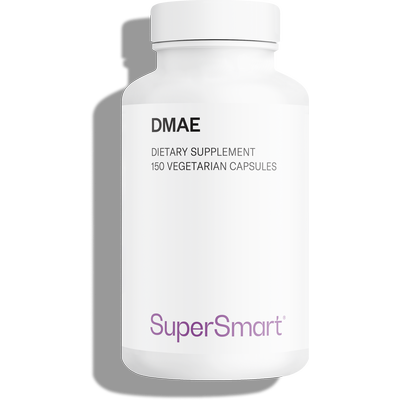
Discover DMAE, a supplement in the form of DMAE bitartrate, easily assimilated by the body.
SUPERSMART ADVICE
References
- Niu YY, Yan HY, Zhong JF, Diao ZQ, Li J, Li CP, Chen LH, Huang WQ, Xu M, Xu ZT, Liang XF, Li ZH, Liu D. Association of dietary choline intake with incidence of dementia, Alzheimer disease, and mild cognitive impairment: a large population-based prospective cohort study. Am J Clin Nutr. 2025 Jan;121 (1) : 5-13. doi: 10.1016/j.ajcnut.2024.11.001. Epub 2024 Nov 7. PMID: 39521435.
- Huang F, Guan F, Jia X, Zhang J, Su C, Du W, Ouyang Y, Li L, Bai J, Zhang X, Wei Y, Zhang B, He Y, Wang H. Dietary Choline Intake Is Beneficial for Cognitive Function and Delays Cognitive Decline: A 22-Year Large-Scale Prospective Cohort Study from China Health and Nutrition Survey. Nutrients. 2024 Aug 26;16(17):2845. doi: 10.3390/nu16172845. PMID: 39275163; PMCID: PMC11397368.
- Bjelland I, Tell GS, Vollset SE, Konstantinova S, Ueland PM. Choline in anxiety and depression: the Hordaland Health Study. Am J Clin Nutr. 2009 Oct ; 90 (4) : 1056-60. doi: 10.3945/ajcn.2009.27493. Epub 2009 Aug 5. PMID: 19656836.
- Spiers PA, Myers D, Hochanadel GS, Lieberman HR, Wurtman RJ. Citicoline improves verbal memory in aging. Arch Neurol. 1996 May;53 (5) : 441-8. doi: 10.1001/archneur.1996.00550050071026. Erratum in: Arch Neurol 1996 Oct;53(10):964. PMID: 8624220.
- Nakazaki E, Mah E, Sanoshy K, Citrolo D, Watanabe F. Citicoline and Memory Function in Healthy Older Adults: A Randomized, Double-Blind, Placebo-Controlled Clinical Trial. J Nutr. 2021 Aug 7;151(8):2153-2160. doi : 10,109 3/jn/nxab119. PMID: 33978188; PMCID: PMC8349115.
- Les références nutritionnelles en vitamines et minéraux, ANSES, 2025
- Yan J, Jiang X, West AA, Perry CA, Malysheva OV, Devapatla S, Pressman E, Vermeylen F, Stabler SP, Allen RH, Caudill MA. Maternal choline intake modulates maternal and fetal biomarkers of choline metabolism in humans. Am J Clin Nutr. 2012 May;95 (5) : 1060-71. doi: 10.3945/ajcn.111.022772. Epub 2012 Mar 14. PMID: 22418088.
- Fischer LM, daCosta KA, Kwock L, Stewart PW, Lu TS, Stabler SP, Allen RH, Zeisel SH. Sex and menopausal status influence human dietary requirements for the nutrient choline. Am J Clin Nutr. 2007 May;85 (5) : 1275-85. doi: 10.1093/ajcn/85.5.1275. PMID: 17490963; PMCID: PMC2435503.
- Penry JT, Manore MM. Choline : an important micronutrient for maximal endurance-exercise performance ? Int J Sport Nutr Exerc Metab. 2008 Apr;18(2):191-203. doi: 10.1123/ijsnem.18.2.191. PMID: 18458362.
Keywords




5 Days
Super fast delivery
Super fast delivery. Trying flexismart at the moment, Maybe a bit too soon to see results bit nice tolérance so far.
Maria Angeles Verdu
5 Days
Good service
Supersmart are an efficient company - the order arrived quickly. This is usual for them, though they have occasionally been let down by delivery firms - not a surprise and not their fault.
Barry Humphries
6 Days
Excellent product
Excellent product, quick delivery
FERENCNE Soros
8 Days
High quality, reliable service!
I have been ordering their products for years! They are excellent quality. And despite the international shipping, my order allways arrived pretty fast. The loyalty program is very fair, I get great prices on the products. Imagine: my specialists are asking me what have I been taking that my counts are so good!
Petra Hruskova
9 Days
I purchased Melatonin
I purchased Melatonin, very quick delivery to the UK and product is perfect. Very Happy
Dean Harriss
11 Days
Avis général
Well boxes are white but that puts a bit of serious color for my grey matter. Supersmart is quality products and made myself a pharmacy. Honestly should be remboursed by the health institutes selling pills
LEBORDAIS Thomas
12 Days
Arrives in just five days even to Japan…
Arrives in just five days even to Japan – that’s insanely fast! Amazing lineup of innovative products.
namio
15 Days
Quality and choice of supplements.
Quality and choice of supplements.
Maja
19 Days
perfect great
perfect great
igor janic
24 Days
Good products and speedy delivery
Good products and speedy delivery
Jim
28 Days
Very good
Very good, fast delivery
Paddy
28 Days
Excellent products
Excellent products. Excellent servce.
MIFSUD Joseph
28 Days
It was sent expediently
It was sent expediently, the tracking worked nicely!
Roger De Backer
30 Days
Everything okay
Quality products people can account on. Fast shipping.
Fred Laan
41 Days
Good products
Good products
Emmanuel
of experience
your money back
##montant## purchase