
Coenzyme Q10: possible effects on mood and fatigue?
Fatigue and low mood may, in some cases, be linked to imbalances in cellular energy. Involved in energy production, coenzyme Q10 has been the subject of a recent study exploring its potential links with these conditions.


What is coenzyme Q10 and what is it used for?
Coenzyme Q10 (or CoQ10) is a molecule naturally produced by the body.
Found in most cells, it plays a key role in the mitochondria, often described as the cell’s ‘powerhouses’.
In particular, it is involved in the production of ATP (adenosine triphosphate), the molecule that provides the energy needed for cells to function, especially in energy-demanding tissues such as the heart, brain and muscles.
Furthermore, CoQ10 also possesses antioxidant activity (1).
It helps to neutralise some of the oxidative stress, an imbalance associated with an excess of free radicals that can disrupt cellular function and be implicated in certain inflammatory processes.
These mechanisms are currently being studied for their potential role in fatigue and mood disorders.
With age or in certain situations, CoQ10 levels may decrease. In this context, supplementation may be considered to provide this molecule.
 Discover the Coenzyme Q10 dietary supplement, which helps to provide CoQ10 as part of a comprehensive nutritional strategy.
Some recent scientific data suggest that taking CoQ10-based dietary supplements may be associated with a reduction in certain symptoms of depression in various populations studied.
However, the results remain inconclusive at this stage with regard to fatigue.
A study published in November 2025 (2) specifically examined these links and the biological mechanisms that may explain them.
A scientific review analyses the links between CoQ10, mood and fatigue
To better understand whether coenzyme Q10 might influence mood or fatigue, researchers conducted a systematic review with a meta-analysis compiling five randomised clinical trials, involving a total of 474 participants.
This review focused on individuals with either a primary depressive disorder (major depression, bipolar disorder) or depressive symptoms associated with other medical conditions (multiple sclerosis, breast cancer or polycystic ovary syndrome).
The authors compared the effects of CoQ10 supplementation with those of a placebo or a control group, examining several criteria such as changes in mood and fatigue.
Why focus on this particular molecule? Because CoQ10 plays a role in mechanisms frequently discussed in relation to these disorders.
For example, mitochondrial dysfunction can affect cellular energy, whilst excessive oxidative stress and low-grade inflammation are sometimes associated with reduced vitality and mood changes.
Thanks to its role in the mitochondrial respiratory chain and its antioxidant activity, CoQ10 is therefore the subject of scientific interest in this context.
After analysing the available data, the authors generally observed a moderate improvement in depressive symptoms, suggesting a potential link between CoQ10 and mood, though this does not allow for a definitive conclusion.
The level of evidence appears, however, to be more limited for fatigue: the results are more heterogeneous and do not, at this stage, allow for a clear conclusion regarding a systematic effect.
The data thus suggest a possible effect of CoQ10 on certain mood parameters, with no established effect on fatigue.
The different forms of coenzyme Q10 as a dietary supplement
When it comes to supplementation, several forms of coenzyme Q10 are available.
The most common is ubiquinone, which is the oxidised form of CoQ10. It can be converted in the body into ubiquinol, its reduced form, which is involved in cellular functions (3).
Formulated with ubiquinone, Coenzyme Q10 is part of a nutritional strategy aimed at providing CoQ10.
Some formulations also combine CoQ10 with other antioxidant compounds, such as tocotrienols, members of the vitamin E family. These are being studied for their interactions with oxidative stress and their role in the cellular environment (4).
Discover Coenzyme Q10 + Tocotrienols, a combination of CoQ10 and vitamin E for a complementary approach.
It is also possible to take ubiquinol directly, the reduced form of coenzyme Q10, which is often presented as having greater bioavailability in certain contexts.
Discover Ubiquinol™, a non-oxidised form of coenzyme Q10.
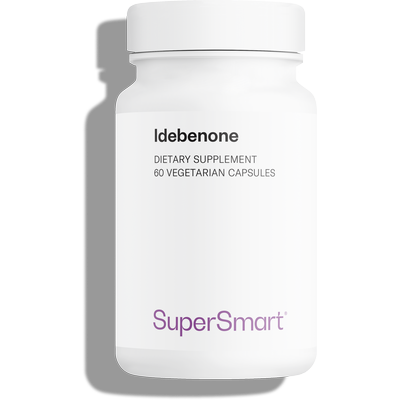
Finally, idebenone is a synthetic analogue of CoQ10, whose shorter chemical structure may influence its distribution at the cellular level. It is being studied for its properties in the mitochondrial respiratory chain and its antioxidant activity.
The dietary supplement Idebenone is a derivative of coenzyme Q10 studied for its interactions with cellular energy metabolism.
Other factors that can exacerbate fatigue and low mood
Fatigue and low mood do not depend solely on cellular energy.
Sleep, exposure to chronic stress, low-grade inflammation and certain nutritional imbalances can also influence emotional balance and vitality.
Among the natural active ingredients studied for their mood-supporting properties, saffron is attracting growing interest for its potential interactions with mood and sleep (5).
The SaffronMag Relax Complex dietary supplement combines saffron, magnesium, L-theanine and vitamin B6 in a holistic approach to well-being.
Omega-3s are also being studied for their role in neuronal membranes and in the regulation of certain inflammatory processes, two factors discussed in relation to mental wellbeing (6).
Combining EPA and DHA, Super Omega 3 is also enriched with vitamin E.
St John’s Wort, meanwhile, is a plant traditionally used to support emotional balance. Due to potential drug interactions, medical advice is recommended before use (7).
Discover St John’s Wort Extract, a St John’s Wort dietary supplement.
5-HTP, a precursor to serotonin, is also being studied for its potential links to mood and sleep (8).
Extracted from the seeds of the African plant Griffonia simplicifolia, the 5-HTP dietary supplement is standardised to 98% 5-HTP.
Magnesium, meanwhile, contributes to the normal functioning of the nervous system and helps reduce fatigue.
The OptiMag supplement combines 8 forms of magnesium.
B vitamins play a role in energy metabolism and the maintenance of normal psychological functions.
Discover the Coenzymated B Formula and Daily 3 dietary supplements, which combine several types of B vitamins that work synergistically.
Finally, rhodiola is an adaptogenic plant studied for its effects on stress, mental fatigue and vitality (9).
The Rhodiola Rosea supplement is a rhodiola extract standardised to 5% rosavin and 1.8% salidroside, its active compounds.
SUPERSMART’S ADVICE
References
- Cirilli I, Damiani E, Dludla PV, Hargreaves I, Marcheggiani F, Millichap LE, Orlando P, Silvestri S, Tiano L. Role of Coenzyme Q10 in Health and Disease: An Update on the Last 10 Years (2010-2020). Antioxidants (Basel). 2021 Aug 23;10(8):1325. doi: 10.3390/antiox10081325. PMID: 34439573; PMCID: PMC8389239.
- Magalhães PLM, da Silva AMP, Maximiano MLB, Fernandes JVA, Amaral DC, Fortes AAT, Filho HNF, Silva LO, Teixeira BDDS, Franco ES, Maia MBS. Effects of Coenzyme Q10 Supplementation on Depressive Symptoms and Fatigue: A Systematic Review and Meta-Analysis of Randomized Controlled Trials. J Clin Psychopharmacol. 2026 Jan-Feb 01;46(1):93-100. doi: 10.1097/JCP.0000000000002112. Epub 2025 Nov 26. PMID: 41294251.
- Mantle D, Dewsbury M, Hargreaves IP. The Ubiquinone-Ubiquinol Redox Cycle and Its Clinical Consequences: An Overview. Int J Mol Sci. 2024 Jun 20;25(12):6765. doi: 10.3390/ijms25126765. PMID: 38928470; PMCID: PMC11203502.
- Ahsan H, Ahad A, Iqbal J, Siddiqui WA. Pharmacological potential of tocotrienols: a review. Nutr Metab (Lond). 2014 Nov 12;11(1):52. doi: 10.1186/1743-7075-11-52. PMID: 25435896; PMCID: PMC4247006.
- Kehtari T, Tovar DC, Epstein D, Junquera P. From Mood to Memory: Unlocking Saffron's Potential in Brain Health. 2025 Apr 24;17(4):e82924. doi: 10.7759/cureus.82924. PMID: 40416274; PMCID: PMC12103703.
- Dighriri IM, Alsubaie AM, Hakami FM, Hamithi DM, Alshekh MM, Khobrani FA, Dalak FE, Hakami AA, Alsueaadi EH, Alsaawi LS, Alshammari SF, Alqahtani AS, Alawi IA, Aljuaid AA, Tawhari MQ. Effects of Omega-3 Polyunsaturated Fatty Acids on Brain Functions: A Systematic Review. 2022 Oct 9;14(10):e30091. doi: 10.7759/cureus.30091. PMID: 36381743; PMCID: PMC9641984.
- Canenguez Benitez JS, Hernandez TE, Sundararajan R, Sarwar S, Arriaga AJ, Khan AT, Matayoshi A, Quintanilla HA, Kochhar H, Alam M, Mago A, Hans A, Benitez GA. Advantages and Disadvantages of Using St. John's Wort as a Treatment for Depression. 2022 Sep 22;14(9):e29468. doi: 10.7759/cureus.29468. PMID: 36299970; PMCID: PMC9587902.
- Li S, Sutanto CN, Xia X, Kim JE. The Impact of 5-Hydroxytryptophan Supplementation on Cognitive Function and Mood in Singapore Older Adults: A Randomized Controlled Trial. 2025 Aug 27;17(17):2773. doi: 10.3390/nu17172773. PMID: 40944161; PMCID: PMC12430700.
- Ivanova Stojcheva E, Quintela JC. The Effectiveness of Rhodiola rosea Preparations in Alleviating Various Aspects of Life-Stress Symptoms and Stress-Induced Conditions-Encouraging Clinical Evidence. Molecules. 2022 Jun 17;27(12):3902. doi: 10.3390/molecules27123902. PMID: 35745023; PMCID: PMC9228580.





2 Days
Super fast delivery
Super fast delivery. Trying flexismart at the moment, Maybe a bit too soon to see results bit nice tolérance so far.
Maria Angeles Verdu
2 Days
Good service
Supersmart are an efficient company - the order arrived quickly. This is usual for them, though they have occasionally been let down by delivery firms - not a surprise and not their fault.
Barry Humphries
3 Days
Excellent product
Excellent product, quick delivery
FERENCNE Soros
5 Days
High quality, reliable service!
I have been ordering their products for years! They are excellent quality. And despite the international shipping, my order allways arrived pretty fast. The loyalty program is very fair, I get great prices on the products. Imagine: my specialists are asking me what have I been taking that my counts are so good!
Petra Hruskova
6 Days
I purchased Melatonin
I purchased Melatonin, very quick delivery to the UK and product is perfect. Very Happy
Dean Harriss
8 Days
Avis général
Well boxes are white but that puts a bit of serious color for my grey matter. Supersmart is quality products and made myself a pharmacy. Honestly should be remboursed by the health institutes selling pills
LEBORDAIS Thomas
9 Days
Arrives in just five days even to Japan…
Arrives in just five days even to Japan – that’s insanely fast! Amazing lineup of innovative products.
namio
12 Days
Quality and choice of supplements.
Quality and choice of supplements.
Maja
16 Days
perfect great
perfect great
igor janic
21 Days
Good products and speedy delivery
Good products and speedy delivery
Jim
25 Days
Very good
Very good, fast delivery
Paddy
25 Days
Excellent products
Excellent products. Excellent servce.
MIFSUD Joseph
26 Days
It was sent expediently
It was sent expediently, the tracking worked nicely!
Roger De Backer
27 Days
Everything okay
Quality products people can account on. Fast shipping.
Fred Laan
38 Days
Good products
Good products
Emmanuel
of experience
your money back
##montant## purchase